
Introduction to Iranian Currency
The Iranian Rial (IRR) is the official currency of the Islamic Republic of Iran, a country with a rich history spanning millennia and an economy that ranks among the largest in the Middle East. For travelers visiting Iran, understanding the local currency system is essential for a smooth and enjoyable trip. The Iranian monetary system presents unique challenges and opportunities that differ significantly from what most international visitors are accustomed to.
Iran's currency situation is complex due to a combination of historical factors, economic sanctions, domestic policies, and rapid inflation. This has resulted in a dual-currency naming convention, significant divergence between official and market exchange rates, and specific financial restrictions that affect both locals and visitors alike. Navigating this system requires some preparation, but with the right knowledge, travelers can manage their finances effectively and avoid common pitfalls.
This comprehensive guide will provide you with everything you need to know about the Iranian Rial, from its historical background and current denominations to practical advice on exchanging money, managing your budget, and understanding the unique aspects of Iran's financial system. Whether you're planning a short visit or an extended stay, this information will help you make informed decisions about your finances while traveling in Iran.
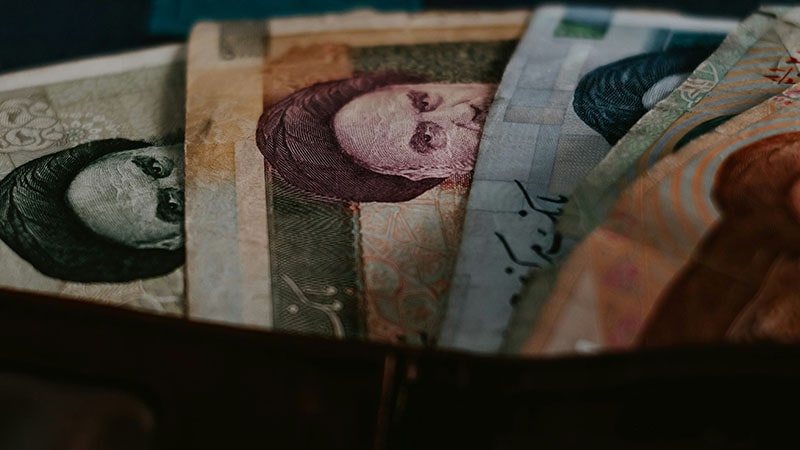
Various denominations of Iranian Rial banknotes and coins
History of Iranian Rial
The Iranian Rial has a fascinating history that reflects the country's economic and political evolution. Understanding this background provides context for the current currency situation in Iran.
Early Monetary Systems in Persia
Before the introduction of the Rial, Persia used various currency systems dating back to ancient times. The first standardized Persian currency was the Daric, introduced during the Achaemenid Empire around 500 BCE. Later, the Sassanian Empire issued silver coins called Drachms. During the Islamic period, the Dinar and Dirham became the standard currencies, influenced by the monetary systems of the Caliphates.
In the 19th century, the Qajar dynasty introduced the Toman as the principal unit of currency, with one Toman equal to 10,000 Dinars. The Rial was first introduced in 1798 as a coin worth 1,250 Dinars or one-eighth of a Toman. However, the Toman remained the primary accounting unit for larger transactions, establishing a pattern of dual currency naming that persists to this day.
Modernization and Standardization
In 1932, as part of Reza Shah Pahlavi's modernization efforts, the Iranian government formally adopted the Rial as the country's official currency, replacing the Qiran at a rate of 1 Rial = 1 Qiran. The Central Bank of Iran (Bank Markazi) was established in 1960 to regulate the currency and implement monetary policy.
Throughout the 20th century, the Rial maintained relative stability, pegged to the British pound and later to the U.S. dollar. Before the 1979 Islamic Revolution, the exchange rate was approximately 70 Rials to 1 US dollar, reflecting Iran's strong economic position as a major oil exporter.
Post-Revolution Developments
The Islamic Revolution of 1979 and subsequent economic sanctions dramatically impacted Iran's currency. The Iran-Iraq War (1980-1988) further strained the economy, leading to increased inflation and currency depreciation. In response to hyperinflation, the government introduced new banknote denominations while removing zeros from the currency in a 2020 proposal that has yet to be fully implemented.
The most significant development in recent decades has been the growing divergence between the official exchange rate set by the government and the market rate determined by supply and demand. This dual exchange rate system emerged as a consequence of economic sanctions and has created challenges for both domestic economic planning and international visitors.
Toman vs Rial: Understanding the Difference
One of the most confusing aspects of Iran's currency system for visitors is the simultaneous use of two different units: the Rial and the Toman. Understanding this dual naming convention is crucial for avoiding financial misunderstandings during your travels.
Official vs Common Usage
The Iranian Rial (IRR) is the official currency of Iran as recognized by the Central Bank and used in all official documents, banking transactions, and international financial reporting. However, in everyday conversation, Iranians almost exclusively use the term "Toman" when discussing prices.
The relationship is simple yet frequently confusing for newcomers: 1 Toman = 10 Rials. This means that when a vendor tells you something costs "50,000 Tomans," they're referring to 500,000 Rials. This unofficial but universally adopted practice stems from historical precedent, as the Toman was the primary currency unit before the Rial was formally adopted in 1932.
Why the Confusion Persists
Several factors contribute to the persistence of this dual system:
- Historical Continuity: The Toman has been used for centuries, creating deep cultural attachment.
- Practical Convenience: With high inflation leading to large numbers, using Toman eliminates one zero from price discussions, making mental calculations easier.
- Psychological Pricing: Items sound cheaper when quoted in Toman rather than Rial.
- Government Inaction: Despite official plans to rename the currency to Toman and drop a zero, implementation has been delayed.
Practical Implications for Travelers
For visitors to Iran, the Rial-Toman distinction has several important implications:
- Always clarify whether a price is quoted in Rials or Tomans to avoid paying ten times more than intended.
- When paying with cash, double-check that you're handing over the correct amount.
- Price tags in shops may use either unit, sometimes with abbreviations (ت for Toman or ﷼ for Rial).
- Digital payment systems and ATMs display amounts in Rials, requiring mental conversion to Tomans for local comparison.
Pro Tip: When discussing prices in Iran, assume people are quoting in Tomans unless specifically stated otherwise. When in doubt, ask "Toman or Rial?" (تومان یا ریال؟).
Banknotes and Coin Denominations
Understanding the various denominations of Iranian currency is essential for handling money effectively during your travels. Due to high inflation, some lower denominations have become obsolete, while new higher denominations have been introduced.
Current Banknotes in Circulation
As of 2025, the following Rial banknotes are commonly used in Iran:
- 100,000 Rials: The most frequently used banknote, featuring Ayatollah Khomeini
- 500,000 Rials: High-value note with image of Imam Reza Shrine
- 1,000,000 Rials: Largest denomination, depicting Shah Cheragh shrine
- 2,000,000 Rials: Recently introduced to reduce the physical bulk of cash transactions
Less common but still in circulation are the 10,000, 20,000, and 50,000 Rial notes. The 5,000 Rial note and lower denominations have largely fallen out of use due to their minimal purchasing power.
Coin Denominations
Iranian coins are still minted but have limited practical use due to inflation:
- 500 Rials: The smallest commonly encountered coin
- 1,000 Rials: Frequently used for small purchases or as change
- 2,000 Rials: Standard coin for minor transactions
- 5,000 Rials: The highest value coin currently minted
Coins below 500 Rials are no longer produced and are essentially worthless in daily transactions. Even the 5,000 Rial coin has minimal purchasing power, equivalent to less than $0.02 USD at market exchange rates.
Security Features
Iranian banknotes incorporate several security features to prevent counterfeiting:
- Watermarks showing historical figures or national symbols
- Security threads that appear as dashed lines when held to light
- Color-shifting ink on higher denominations
- Microprinting and raised printing for tactile identification
- UV-reactive elements visible under ultraviolet light
When receiving large denominations, especially in informal exchange situations, it's wise to check for these security features to avoid accepting counterfeit notes.
Exchange Rates and Currency Valuation
The valuation of the Iranian Rial is one of the most complex and dynamic aspects of Iran's economy, characterized by multiple exchange rates and significant fluctuations.
Dual Exchange Rate System
Iran operates with a dual exchange rate system consisting of:
- Official Rate (NIMA): Set by the Central Bank of Iran for essential imports like medicine and basic food items
- Market Rate: Determined by supply and demand in open currency markets
The gap between these rates can be substantial, sometimes differing by 50% or more. Travelers will almost always use the market rate when exchanging foreign currency, as the official rate is reserved for specific transactions and not accessible to tourists.
Factors Influencing Rial Valuation
Several factors contribute to the Rial's volatility and depreciation trend:
- Economic Sanctions: Restrictions on oil exports and international banking have severely limited Iran's foreign currency earnings
- Inflation: High domestic inflation rates, often exceeding 40% annually, erode purchasing power
- Political Uncertainty: Domestic and international political developments directly impact currency markets
- Oil Prices: As an oil-dependent economy, global crude prices significantly affect currency stability
- Speculation: Currency speculation during periods of uncertainty can trigger rapid devaluation
Historical Exchange Rate Trends
The Iranian Rial has experienced significant depreciation over recent decades:
- 1975: Approximately 70 Rials to 1 USD
- 2000: Approximately 8,000 Rials to 1 USD
- 2010: Approximately 10,000 Rials to 1 USD
- 2018: Approximately 45,000 Rials to 1 USD
- 2023: Approximately 500,000 Rials to 1 USD
- 2025: Approximately 600,000 Rials to 1 USD (market rate)
This dramatic depreciation reflects both domestic economic policies and the impact of international sanctions, particularly those reimposed after the U.S. withdrawal from the JCPOA nuclear agreement in 2018.
Important: Exchange rates can fluctuate significantly in short periods. Check current market rates shortly before your trip and during your stay using reliable local sources or currency apps that track the Iran market rate.
How to Exchange Money in Iran
Exchanging foreign currency in Iran requires some knowledge of the local system to ensure you get fair rates and avoid legal issues. Here's what every traveler needs to know about money exchange in Iran.
Where to Exchange Money
Travelers have several options for exchanging currency in Iran:
- Official Exchange Offices (Sarrafi): Licensed currency exchange offices found in major cities, particularly in tourist areas and commercial districts. These offer competitive rates and are generally reliable.
- Hotels: Most mid-range and luxury hotels offer currency exchange services, though rates are typically less favorable than at exchange offices.
- Private Exchange: Informal money changers operate in major bazaars and tourist areas. While they may offer slightly better rates, there's higher risk of receiving counterfeit notes or short counts.
- Banks: Iranian banks can exchange currency but typically offer less favorable official rates rather than market rates.
Best Currencies to Bring
Not all foreign currencies are equally easy to exchange in Iran:
- Euros (EUR): The most widely accepted and easily exchanged foreign currency
- U.S. Dollars (USD): Readily accepted despite political tensions, though some exchange offices may be hesitant
- British Pounds (GBP): Generally accepted in major cities
- UAE Dirhams (AED): Easily exchanged due to close trade relations
- Other Major Currencies: Canadian dollars, Australian dollars, Swiss francs, and Japanese yen can be exchanged but may receive slightly less favorable rates
It's advisable to bring a mix of Euros and U.S. dollars in various denominations, with an emphasis on newer, crisp bills as some exchange offices may reject worn or damaged currency.
Exchange Process and Documentation
When exchanging money at official exchange offices (Sarrafi), you'll typically need to:
- Present your passport for registration
- Complete a brief form with personal details
- Receive a receipt for the transaction (keep this for potential reconversion when departing)
- Count your money carefully before leaving the establishment
There are no limits on the amount of foreign currency you can bring into Iran, but amounts over €10,000 or equivalent must be declared upon arrival. When leaving Iran, you can reconvert unused Rials back to foreign currency up to the amount shown on your exchange receipts, though this process can be cumbersome.
Banking and Financial Restrictions
Iran's banking system operates under significant constraints due to international sanctions, creating unique challenges for travelers. Understanding these restrictions is crucial for effective financial planning.
International Banking Limitations
Due to sanctions, Iran's banking system is largely disconnected from global financial networks:
- No International ATM Access: Foreign debit and credit cards (Visa, MasterCard, American Express, etc.) do not work in Iran
- Limited Wire Transfers: International bank transfers to Iran are extremely difficult and often impossible
- No Credit Card Payments: You cannot use international credit cards for purchases in Iran
- Currency Restrictions: Some countries may have restrictions on financial transactions with Iran
These limitations mean travelers must bring all the money they'll need for their entire trip in cash. While this may seem concerning, Iran is generally a safe country with low rates of violent crime, though standard precautions against theft should be observed.
Domestic Banking Services
Despite international restrictions, Iran has a sophisticated domestic banking system:
- Local ATMs: Work with Iranian debit cards but not international cards
- Shetab Network: Iran's domestic payment processing system that connects all Iranian banks
- Local Credit Cards: Iranian banks issue their own credit cards for use within the country
- Bank Accounts for Foreigners: It is possible for foreigners to open bank accounts in Iran, though the process can be bureaucratic
Practical Implications for Travelers
The banking restrictions have several important implications for visitors:
- Bring sufficient cash in stable foreign currencies (Euros are recommended) for your entire trip
- Calculate your budget carefully, including a contingency fund for emergencies
- Use a money belt or hotel safe to secure your cash
- Exchange money in small amounts rather than all at once to minimize risk
- Consider using prepaid travel cards from specialized providers that work in Iran (availability is limited)
Budgeting and Money Management Tips
Effective money management is essential for a stress-free trip to Iran. With proper planning, you can make your money go further while avoiding common financial pitfalls.
Daily Budget Estimates
Iran can be a very affordable destination, though costs vary significantly depending on your travel style:
- Budget Traveler: $25-40 USD per day
- Dormitory beds or budget hotels: $10-15
- Street food and local restaurants: $8-12
- Public transportation: $3-5
- Attraction entry fees: $4-8
- Mid-Range Traveler: $50-80 USD per day
- Comfortable hotels or guesthouses: $25-40
- Restaurant meals: $15-25
- Private taxis and domestic flights: $10-15
- Guided tours and entrance fees: $10-15
- Luxury Traveler: $100-200+ USD per day
- Boutique or 5-star hotels: $60-120
- Fine dining: $30-50
- Private drivers and guides: $40-60
- Shopping and special experiences: Variable
Cost-Saving Strategies
Stretch your budget further with these practical tips:
- Travel During Off-Peak Seasons: Prices for accommodation can be 30-50% lower outside of Nowruz (Iranian New Year in March) and summer holidays
- Use Public Transportation: Iran has an extensive and affordable network of buses, metro systems, and shared taxis
- Eat Like a Local: Street food and traditional restaurants offer delicious meals at a fraction of tourist restaurant prices
- Stay in Guesthouses: Traditional Iranian guesthouses (often called "Mosaferkhaneh" or "Ecolodge") provide authentic experiences at reasonable prices
- Bargain Respectfully: Negotiation is expected in bazaars and for taxi fares, but maintain a friendly attitude
Managing Large Amounts of Cash
Carrying sufficient cash for your entire trip requires careful management:
- Use a money belt or hidden pouch for the majority of your cash
- Keep spending money for the day in a separate wallet
- Utilize hotel safes when available
- Divide your money between different bags in case of loss or theft
- Consider traveling with a companion to split cash carrying responsibilities
- Keep a record of exchange rates and serial numbers of high-denomination bills
Digital Payments and Fintech in Iran
Despite international banking restrictions, Iran has developed a robust domestic digital payment ecosystem that offers convenience for locals and limited options for visitors.
Domestic Payment Systems
Iran's primary digital payment infrastructure includes:
- Shetab: The interbank network that connects all Iranian banks and allows ATM and point-of-sale transactions across different banks
- SHAPARAK: Iran's domestic card payment switch that processes transactions from Iranian-issued debit and credit cards
- Local Payment Apps: Various Iranian-developed applications like "Beh Pardakht" and "Mega Pay" that facilitate mobile payments
Options for Travelers
While international payment cards don't work in Iran, travelers have some limited options for digital payments:
- Prepaid Iranian Cards: Some exchange offices and hotels offer prepaid Iranian debit cards that can be loaded with Rials for use at domestic terminals
- Local SIM Cards: Purchasing an Iranian SIM card allows access to some payment apps, though registration requires a local phone number
- Hotel and Tour Company Payments: Some larger hotels and tour operators have workarounds to accept international payments, though often at less favorable exchange rates
Future Developments
Iran is actively developing its fintech sector with several initiatives:
- Central Bank Digital Currency: Research and development of a digital Rial
- Blockchain Technology: Exploration of blockchain for financial transactions to circumvent sanctions
- International Partnerships: Efforts to establish payment corridors with neighboring countries
- Tourist Payment Solutions: Development of specialized payment options for international visitors
While these developments show promise, for the foreseeable future, cash will remain the primary payment method for travelers in Iran.
Future of Iranian Currency
The Iranian Rial faces significant challenges but also potential opportunities for reform and stabilization in the coming years.
Currency Reform Initiatives
The Iranian government has proposed several currency reforms to address economic challenges:
- Currency Redenomination: Plans to remove four zeros from the Rial and potentially rename it as the Toman
- Unified Exchange Rate: Efforts to eliminate the dual exchange rate system
- Digital Transformation: Increasing digitization of financial transactions to reduce reliance on cash
- International Reintegration: Potential reintegration into global financial systems if sanctions are lifted
Economic Factors Influencing Future Stability
Several key factors will determine the future trajectory of the Iranian Rial:
- Sanctions Relief: Potential easing of international sanctions would significantly strengthen the currency
- Oil Export Revenues: Increased oil exports would boost foreign currency reserves
- Domestic Economic Policies: Fiscal discipline and monetary policy effectiveness
- Regional Integration: Strengthened economic ties with neighboring countries and trading partners
- Technological Adoption: Implementation of financial technology to improve efficiency and transparency
Implications for Travelers
Potential currency reforms could impact future travelers to Iran:
- Simplified calculations if the Toman becomes the official currency
- Reduced need to carry large amounts of cash with lower denominations
- Potential for international payment card acceptance if banking restrictions ease
- More stable pricing and budgeting predictability
- Possible temporary confusion during transition periods
While significant reforms may take time to implement, travelers should stay informed about potential changes that could affect their financial planning for Iran trips.
Final Money Tips for Travelers to Iran
Navigating Iran's currency system may seem daunting at first, but with proper preparation, you can manage your finances effectively and focus on enjoying this fascinating country. Here are our final essential tips:
Essential Preparations
- Bring all the cash you'll need for your entire trip in stable foreign currencies (Euros are most recommended)
- Carry a mix of denominations, with an emphasis on newer, crisp bills
- Inform your bank of your travel plans to avoid account issues, but understand your cards won't work in Iran
- Research current exchange rates shortly before departure
- Download currency converter apps that work offline
During Your Trip
- Always clarify whether prices are quoted in Rials or Tomans
- Exchange money in small amounts at licensed exchange offices (Sarrafi)
- Keep exchange receipts for potential reconversion when departing
- Use a money belt or hotel safe to secure your cash
- Count your money carefully during exchanges and transactions
- Be prepared for cash-only transactions nearly everywhere
Cultural and Practical Considerations
- Bargain respectfully in markets and for taxi fares
- Understand that Iranians may discuss money more openly than in some cultures
- Be patient with bureaucratic processes related to money exchange
- Keep small denominations handy for tips, donations, and small purchases
- Consider the psychological impact of dealing with large numbers and adjust your mental calculations accordingly
Final Thought: While Iran's currency system presents unique challenges, it shouldn't deter you from visiting this incredible country. With proper preparation and the information in this guide, you can navigate financial matters confidently and focus on experiencing Iran's rich culture, history, and legendary hospitality.
We hope this comprehensive guide to the Iranian Rial has provided you with valuable insights and practical advice for managing money during your travels in Iran. Safe travels and enjoy your Iranian adventure!
Comments and Questions
Have questions about money in Iran? Share your thoughts or ask for clarification in the comments below!